You can use the "Landed Cost Journal" to make manual adjustments and corrections to the "Landed Cost Ledger Entries". It is most often used to write off expected landed costs that are no longer expected to be invoiced, so that the receipt no longer shows as having outstanding landed costs.
Note: for Purchase Receipts, posting a Landed Cost Journal only updates the Landed Cost Ledger and does not post any financial transaction. Any adjustment needed in the General Ledger (for example to clear an accrual that will not be invoiced) must be made with a standard Business Central General Journal.
Note: for Transfer Receipts where the Landed Cost Type uses the Charge Item Cost Treatment, posting an Invoice line reverses the accrual that was posted at receipt and posts an Item Charge Value Entry for the difference between the expected cost and the Cost Amount (Actual) on the line. This does update the General Ledger and the Item's inventory value.
Journal Batches
Multiple "Landed Cost Jnl. Batches" can be created so that each user has their own journal to work in when adjusting landed costs. To do this, click the ellipsis next to the Batch Name field and select New to create a new "Landed Cost Jnl. Batch", as shown below.
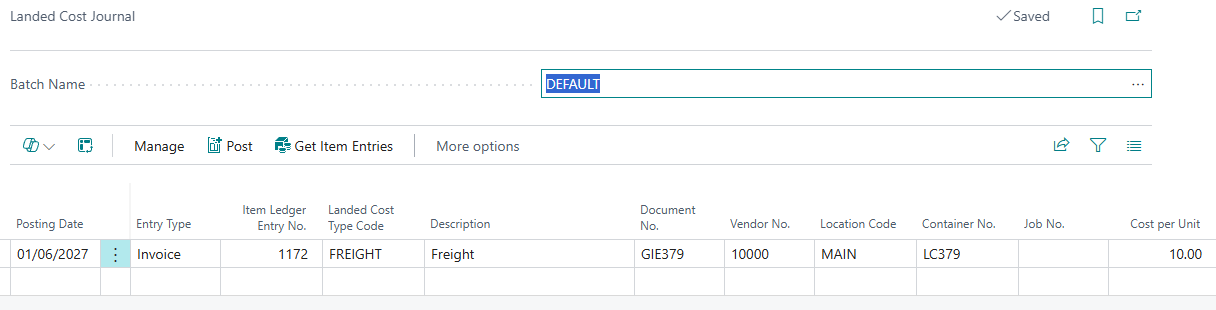
The first time the journal is opened, a DEFAULT journal template and a DEFAULT batch are created for you automatically. Journal templates can be maintained from the "Landed Cost Journal Templates" screen, which you can open from the Landed Cost Journal Templates action on the "Landed Cost Setup" screen.
Writing off expected landed costs
To retrieve outstanding expected landed costs on to the journal, select Get Item Entries from the Process menu. The "LC Journal Get Entries" screen opens and lists the Item Ledger Entries that still have open landed costs.
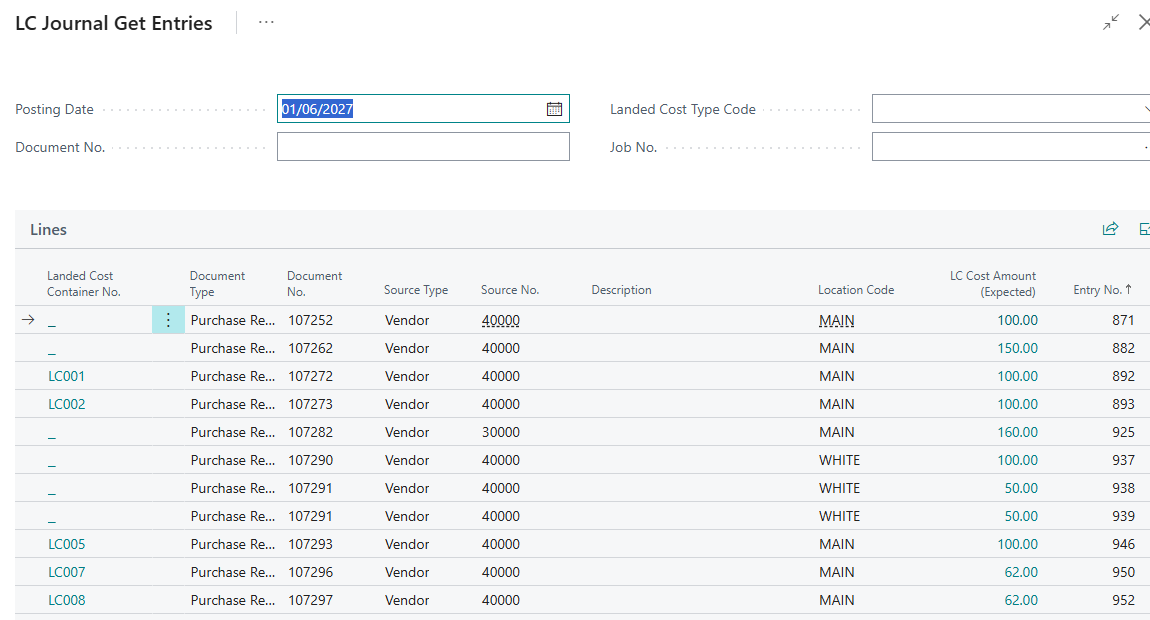
Complete the fields at the top of the screen and then select the Item Ledger Entries you want to adjust.
| Posting Date | The posting date that will be given to the journal lines. This defaults to the work date. |
| Document No. | The document number that will be given to the journal lines. This field must be completed. |
| Landed Cost Type Code | The "Landed Cost Type" you want to adjust. This field must be completed. When you enter a value, the LC Cost Amount (Expected) column in the list shows the expected cost for that Landed Cost Type only. |
| Job No. | Filters the list to Item Ledger Entries for a specific Landed Cost Job No. The lookup shows your "Landed Cost Containers" and uses the Job No. of the container you select. |
The list shows the Landed Cost Container No., Document Type, Document No., Source Type, Source No., Description, Location Code, LC Cost Amount (Expected) and Entry No. of each Item Ledger Entry. Select one or more lines and click OK.
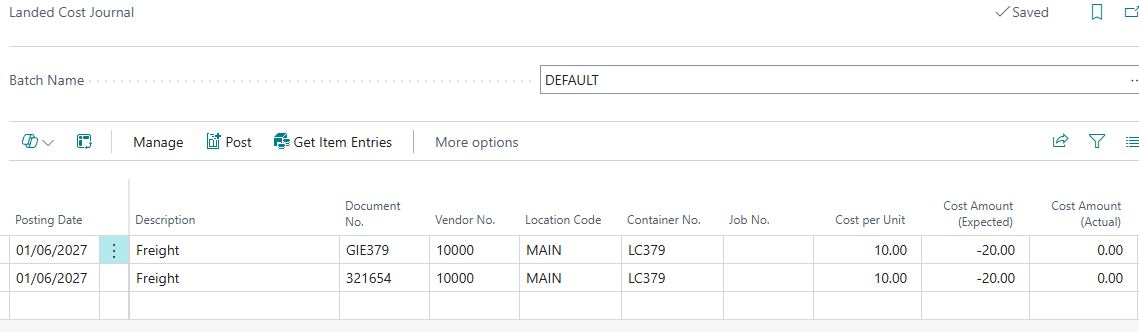
For each selected Item Ledger Entry that has an open receipt entry for the chosen Landed Cost Type, a journal line is created with:
-
an Entry Type of Invoice
-
the Posting Date and Document No. you entered
-
the Item Ledger Entry, Vendor, Location, Container, Job and dimension details copied from the original receipt entry
-
a Cost Amount (Expected) equal to the outstanding expected cost shown as a negative value, and a Cost Amount (Actual) of zero
To write off the whole expected cost, leave Cost Amount (Actual) as zero. If part of the cost has been or will be incurred, enter that amount in Cost Amount (Actual).
Note: posting an Invoice line closes the open receipt entry for that Item Ledger Entry and Landed Cost Type, whatever amount you enter in Cost Amount (Actual). No further landed cost can then be invoiced against that receipt entry.
Posting the journal
Once you are happy with the adjustments on the journal, select Post from the Process menu (or press F9). You can also post one or more whole batches by selecting Post on the "Landed Cost Jnl. Batches" screen.
Before posting, each line is checked. The line must have a Landed Cost Type Code, Item Ledger Entry No., Posting Date and Document No., and the Item No. and Vendor No. must match the Item Ledger Entry. For Receipt and Invoice lines the posting setup is also checked:
-
Default Cost Treatment - the Landed Cost Type must have an Accrual Account. For Purchase Receipts it must also have a Variance Account, and the "General Posting Setup" for the Vendor and Item must have an Invt. Accrual Acc. (Interim). For Transfer Receipts it must have a Transfer Variance Account.
-
Charge Item Cost Treatment on Transfer Receipts - the "General Posting Setup" for the Landed Cost Type's Gen. Bus. Posting Group and the Charge Item's Gen. Prod. Posting Group must have a Direct Cost Applied Account and an Invt. Accrual Acc. (Interim).
When the journal is posted:
-
a Landed Cost Ledger Entry is created for each line and, for Invoice lines, the open receipt entries for the same Item Ledger Entry and Landed Cost Type are closed (the Closed by Entry No. and Closed at Date fields are completed)
-
when no expected landed cost remains on the Item Ledger Entry, its Landed Costs Open field is cleared so it no longer appears in "Get Item Entries" or on landed cost invoices
-
a "Landed Cost Register" record is created showing the entries posted and the Journal Batch Name
See Landed Cost Ledger Entries for more information about the entries created, and Landed Cost Register for the audit trail of each posting.
Journal lines
The following fields are available on the journal lines.
| Posting Date | The posting date of the Landed Cost Ledger Entry that will be created. |
| Entry Type | The type of ledger entry to create: Receipt, Invoice, Variance or Reversal. Lines created by Get Item Entries use Invoice, which is the type that closes an open receipt entry. |
| Item Ledger Entry No. | The Item Ledger Entry the landed cost relates to. When you enter a value, the Item, Location, Container, Job and Vendor details are copied from the Item Ledger Entry. |
| Landed Cost Type Code | The "Landed Cost Type" being adjusted. The Description is taken from the Landed Cost Type. |
| Description | A description of the line. |
| Document Type | The type of posted document the line relates to. Hidden by default. |
| Document No. | A document number for the journal line. This field must be completed before posting. |
| Document Line No. | The line number of the posted document the line relates to. Hidden by default. |
| Vendor No. | The Vendor of the original receipt. For Purchase Receipts this must match the Vendor on the Item Ledger Entry. |
| Location Code | The Location of the Item Ledger Entry. |
| Container No. | The "Landed Cost Container" the receipt relates to. Entering a container also fills in its Job No. |
| Job No. | The Landed Cost Job No. the receipt relates to. |
| Cost per Unit | The landed cost per unit. |
| Cost Amount (Expected) | The expected cost being removed. On lines created by Get Item Entries this is the outstanding expected cost shown as a negative value. |
| Cost Amount (Actual) | The actual cost to record. Leave this as zero to write off the whole expected cost. |
Below the lines, the Landed Cost Type of the selected line is shown.
Other actions
The following actions are also available on the "Landed Cost Journal" screen.
| Card | Found in the Landed Costs menu. Opens the "Landed Cost Rules" screen for the Landed Cost Type on the selected line (Shift+F7). |
| Ledger Entries | Found in the Landed Costs menu. Opens the "Landed Cost Ledger Entries" screen for the Landed Cost Type on the selected line (Ctrl+F7). |
| Dimensions | Found in the Line menu. View or edit the dimensions for the journal line. |