Now that the setup has been completed you can start using Clever Landed Costs within your procurement process.
Simply enter the Item details on the "Purchase Order", as you would for any type of purchase, and the applicable Landed Costs for the Item will be retrieved based on the Item Landed Cost Assignment and Incoterm Allocation setup.
Note: Document Landed Costs are only created for lines with a Type of Item on a "Purchase Order", and only for Items with a Type of Inventory. They are not created on purchase invoices, credit memos or return orders.
The landed costs for a line are deleted and retrieved again whenever you change the No., Location Code, Unit of Measure Code or Expected Receipt Date on the line. The Expected Receipt Date is used as the effective date when the rates are looked up. When Incoterm Allocation Enabled is set on the "Landed Cost Setup" screen, changing the Shipment Method Code on the header also retrieves the landed costs again for every Item line.
Note: When landed costs are retrieved again, any changes you made manually on the "Document Landed Costs" screen for that line are replaced.
Landed Costs FastTab
A Landed Costs FastTab is added to the "Purchase Order" screen, after the Foreign Trade FastTab. It shows the status of any Fixed Costs for the order.
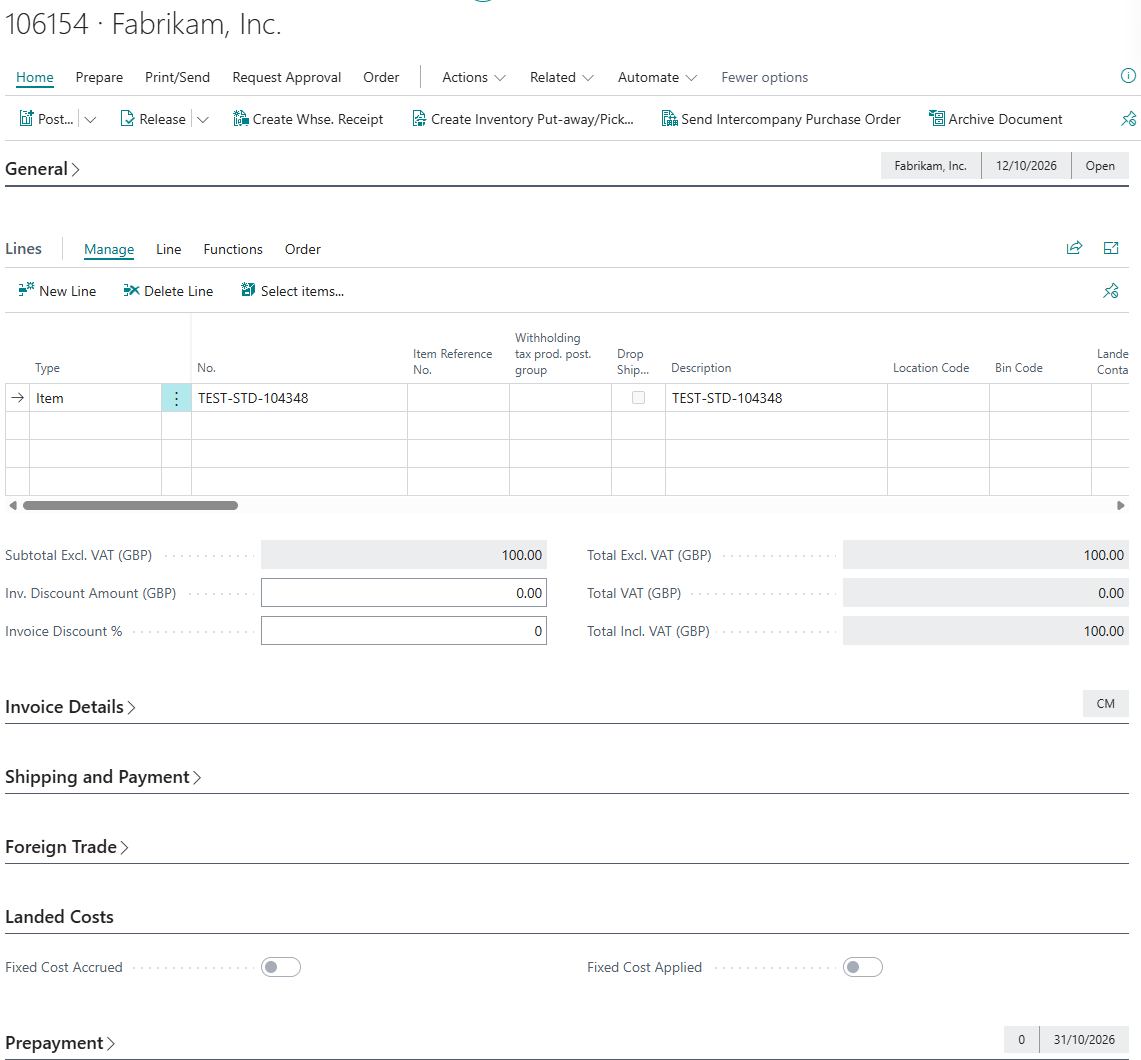
| Fixed Cost Accrued | Set when all of the Fixed Costs for the Purchase Order have been accrued, meaning the expected cost has been posted to inventory. This field cannot be edited. |
| Fixed Cost Applied | Set when all of the Fixed Costs for the Purchase Order have been fully applied, meaning the actual cost has been posted to inventory. This field cannot be edited. |
Landed Costs Actions
The following actions are available from the Landed Costs menu on the "Purchase Order" screen.
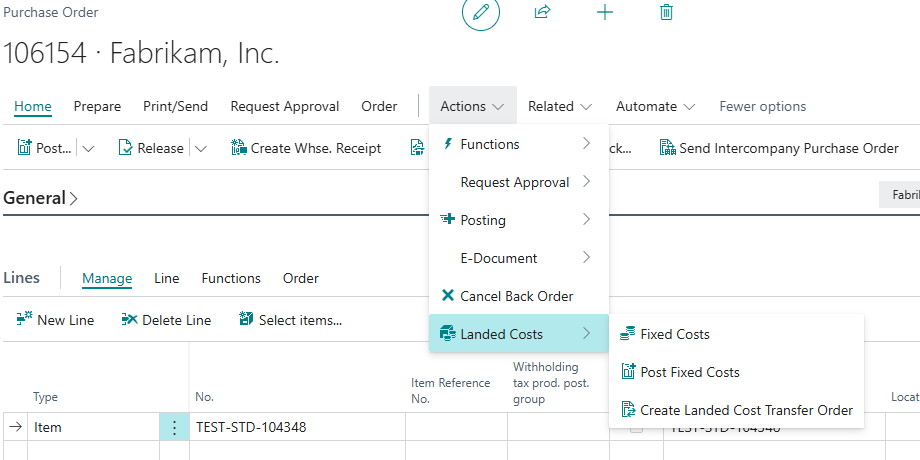
| Fixed Costs | Opens the "Document Fixed Costs" screen, where you can view or edit the Fixed Costs for the Purchase Order. Fixed Costs are document-level landed costs, such as a flat freight charge, that are not tied to individual lines. |
| Post Fixed Costs | Posts the Fixed Cost accruals for the Purchase Order based on the quantities received so far. See Receipt Cost Posting. |
| Create Landed Cost Transfer Order | Creates a "Transfer Order" from the Purchase Order. See the Transfer Orders section below. |
Fixed Costs
Additionally (from Version 5.0.0) if you set up any Fixed Cost for Purchase Orders then, depending on the Purchase Order attributes (Buy-from Vendor No., Location Code and Shipment Method Code), any relevant Fixed Costs will be retrieved. To view any Fixed Costs you can access them by selecting Fixed Costs from the Landed Costs menu. For details of how Fixed Costs are set up see Fixed Cost Assignment.
The "Document Fixed Costs" screen shows the Landed Cost Type Code, the Calculation Type used to share the cost across the received Items, and the Amount (LCY) to be shared. You can also use the Dimensions action to view or edit the dimensions for a Fixed Cost line.
Fixed Costs can also be updated or removed manually from a Purchase Order as required. Only a "Landed Cost Type" with a Cost Treatment of Charge Item can be used as a Fixed Cost. Furthermore, if Fixed Costs are likely to change after Release of the document (but before the document is completely handled, at which point costs are posted) you can update them as required, if you have enabled the Fixed Costs Editable When Released field on the "Landed Cost Setup" screen. Otherwise the "Document Fixed Costs" screen is read-only once the order is released.
Note: The suggested Fixed Costs are refreshed when you add a new Item line or change the Buy-from Vendor No., Location Code or Shipment Method Code on the order, so make any manual changes to the Fixed Costs after the order lines are complete.
Purchase Order Lines
The following fields are added to the lines of the "Purchase Order" screen. Some are hidden by default and can be added using Personalise.
| Landed Cost Container No. | The "Landed Cost Container" that the line is assigned to. This can only be set on a line where the Type is Item. Setting it also copies the container's Job No. to the line and sets the container quantity for the line to the line Quantity. |
| Landed Cost Job No. | The Job No. taken from the assigned "Landed Cost Container". This field cannot be edited and is hidden by default. It is carried through to the Item Ledger Entries and the Landed Cost Ledger Entries when the line is received. |
| Exclude from Fixed Cost | When set, the line does not receive a share of the Purchase Order Fixed Costs. |
| Overhead Rate | The standard Business Central field, shown on the lines by the app. It is set to the total of the Document Landed Costs for the line that use the Default Cost Treatment, so that these costs are included in the line Unit Cost (LCY). Costs that use the Charge Item Cost Treatment are not included, because they are posted as separate item charge value entries. |
| Landed Unit Cost (Base) (LCY) | The total of all Document Landed Costs for the line, per base unit of measure, in local currency. |
| Total Landed Cost (LCY) | The Quantity (Base) multiplied by the Landed Unit Cost (Base) (LCY), giving a quick overview of the landed cost for the whole line. |
Note: You cannot change the Overhead Rate manually on a line that has Document Landed Costs. Change the costs on the "Document Landed Costs" screen instead.
In relation to Fixed Costs, the Exclude from Fixed Cost field can be set for any Item on the Purchase Order that should not attract a share of the Fixed Costs. This is often relevant for importers when empty Container space is used to procure "filler" Items to utilise all available Container space, but where those Items should not attract a share of the fixed costs.
Document Landed Costs
For individual Items on the Purchase Order you can see which landed costs are assigned to them by viewing the "Document Landed Costs" screen. You can access this screen from the Line menu by selecting the Document Landed Costs option, as shown below. The "Document Landed Costs" will be shown for the current Item Line.
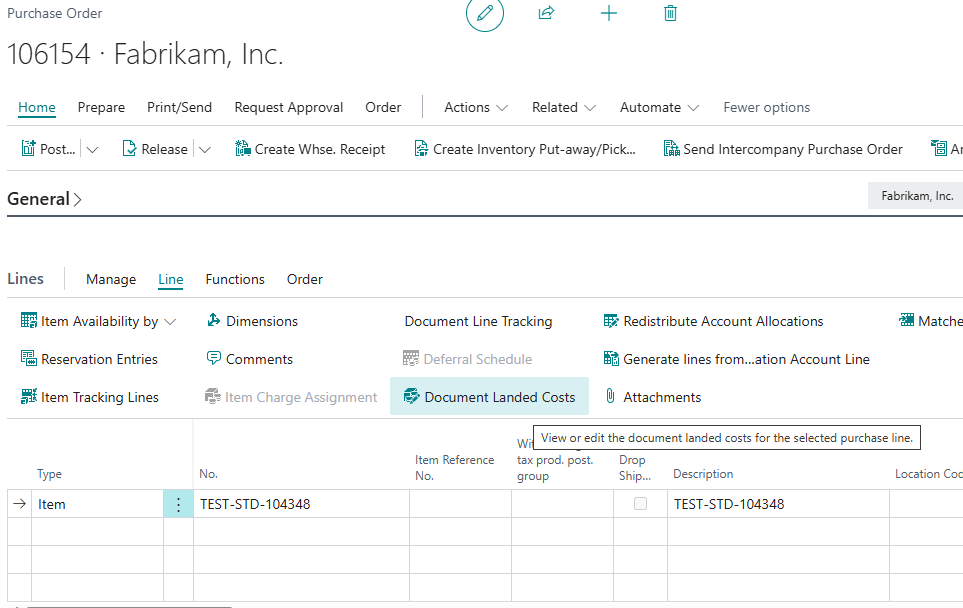
Within the "Document Landed Costs" screen you are able to update the costs, allowing you to add, change and remove landed costs for the line.
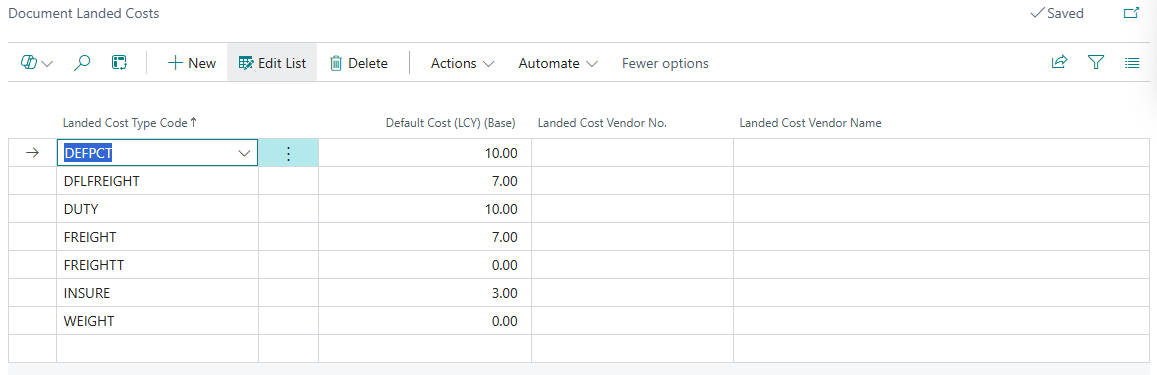
| Landed Cost Type Code | The "Landed Cost Type" for the cost. When you enter a type manually, the default cost is taken from the "Landed Cost Type": a Percent type uses its Default Cost % against the Item base cost, a Duty type is calculated from the base cost plus any costs marked Include in Duty, and any other type uses its Default Cost. The dimensions are also set from the line and the "Landed Cost Type". |
| Default Cost (LCY) (Base) | The cost per base unit of measure, in local currency. You can overwrite the value. A cost you change manually is no longer recalculated when the line price changes, and any Duty cost on the line is recalculated to include it. |
| Landed Cost Vendor No. | The vendor that you expect to receive the landed cost invoice from. It is taken from the landed cost rate, or from the "Landed Cost Type" when the rate has no vendor, and you can change it for this document. |
| Landed Cost Vendor Name | The name of the Landed Cost Vendor No.. This field cannot be edited. |
Use the Dimensions action on the "Document Landed Costs" screen to view or edit the dimensions for a landed cost. The dimensions combine the dimensions of the purchase line with the default dimensions of the "Landed Cost Type", and they are updated when you change the dimensions on the purchase line or the header. These dimensions are used when the landed cost is posted at receipt.
When you change the Direct Unit Cost on the line, Percent and Duty costs that have not been changed manually are recalculated. If Use Net Purchase Price is set on the "Landed Cost Setup" screen, the base cost is the line amount after line and invoice discounts, so changes to Line Discount %, Line Discount Amount and the invoice discount also recalculate these costs. If you delete a landed cost, the Duty cost and the Overhead Rate are recalculated.
Note: Once any quantity has been received on the line, the Landed Cost Type Code and Default Cost (LCY) (Base) can no longer be changed, and Percent and Duty costs are no longer recalculated.
From Version 5.0.0 of Clever Landed Costs you can also see the Landed Unit Cost (Base) (LCY) and the Total Landed Cost (LCY) for each Item line, providing a quick overview of any associated Landed Costs.
Rate Changes and Re-calculating Rates on Receipt
If you change a landed cost rate while it is used on Purchase Order or Transfer Order lines that still have an outstanding quantity, you are asked whether you want to update the rate against the existing Document Landed Costs for that "Landed Cost Type". If you choose Yes, the matching Document Landed Costs are updated.
If Re-calculate Rates on Receipt is set on the "Landed Cost Setup" screen, the landed costs for each line being received are retrieved again when you post the receipt, using the Posting Date as the effective date. Any landed cost type that you removed from the line stays removed, and any Landed Cost Vendor No. that you set is kept.
Landed Cost Containers
Within the Purchase Order it is possible to view and manually assign an Item line to a pre-existing "Landed Cost Container" using the Landed Cost Container No. field. You can also use the Create Container & Assign Lines action, which is available from the Functions menu on the lines. This creates a new "Landed Cost Container", using the "No. Series" assigned to Container Nos. on the "Landed Cost Setup" screen, and opens it on the "Landed Cost Container Detail" screen so that you can complete the container details and assign the lines. See Landed Cost Containers.
Note: trying to assign a Landed Cost Container No. against any line where the Type is not Item will result in an error.
Transfer Orders
With the introduction of Transfer Order functionality in Version 5.0.0 of Clever Landed Costs it is possible to create (and therefore link) a transfer to the purchase. This not only means that for relevant Incoterms (where you need to Purchase and Transfer the goods) it is possible to have the system populate a Transfer Order with the relevant information, it is also especially useful to be able to synchronise the Transfer Order with updates to cost, quantity and tracking information.
Select Create Landed Cost Transfer Order from the Landed Costs menu. You will be prompted to enter the Transfer-to Code to confirm which Location the Transfer Order will be received into. This cannot be an in-transit location. The system will then create a new Transfer Order, show a message with its number, and open it.
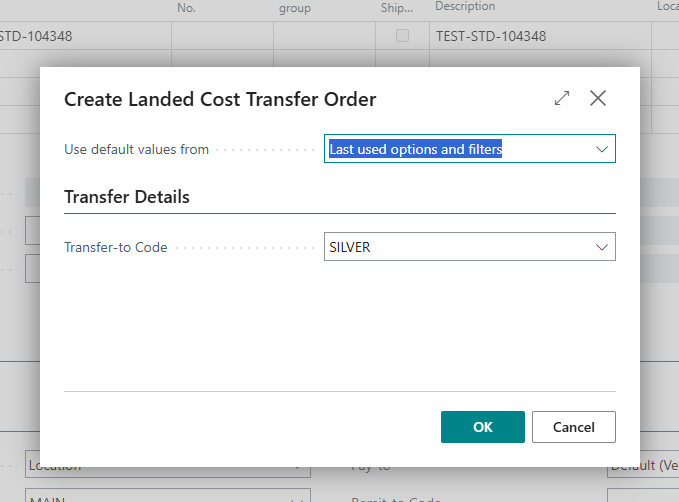
Note: The Purchase Order must have a Location Code, because this is used as the Transfer-from Code. The In-Transit Code is taken from the Transfer Route between the two locations.
The new Transfer Order is created with the following information:
-
one transfer line for each Item line on the Purchase Order, with the same Item, variant, unit of measure, quantity and descriptions
-
the Landed Cost Container No., Landed Cost Job No. and Exclude from Fixed Cost values from each purchase line
-
a Base Cost (LCY) for each line, calculated as the purchase line Direct Unit Cost per base unit of measure
-
the dimensions and any lot, serial or package tracking from each purchase line
-
the Shipment Method Code from the Purchase Order, to ensure that the relevant Fixed Costs are populated onto the Transfer Order
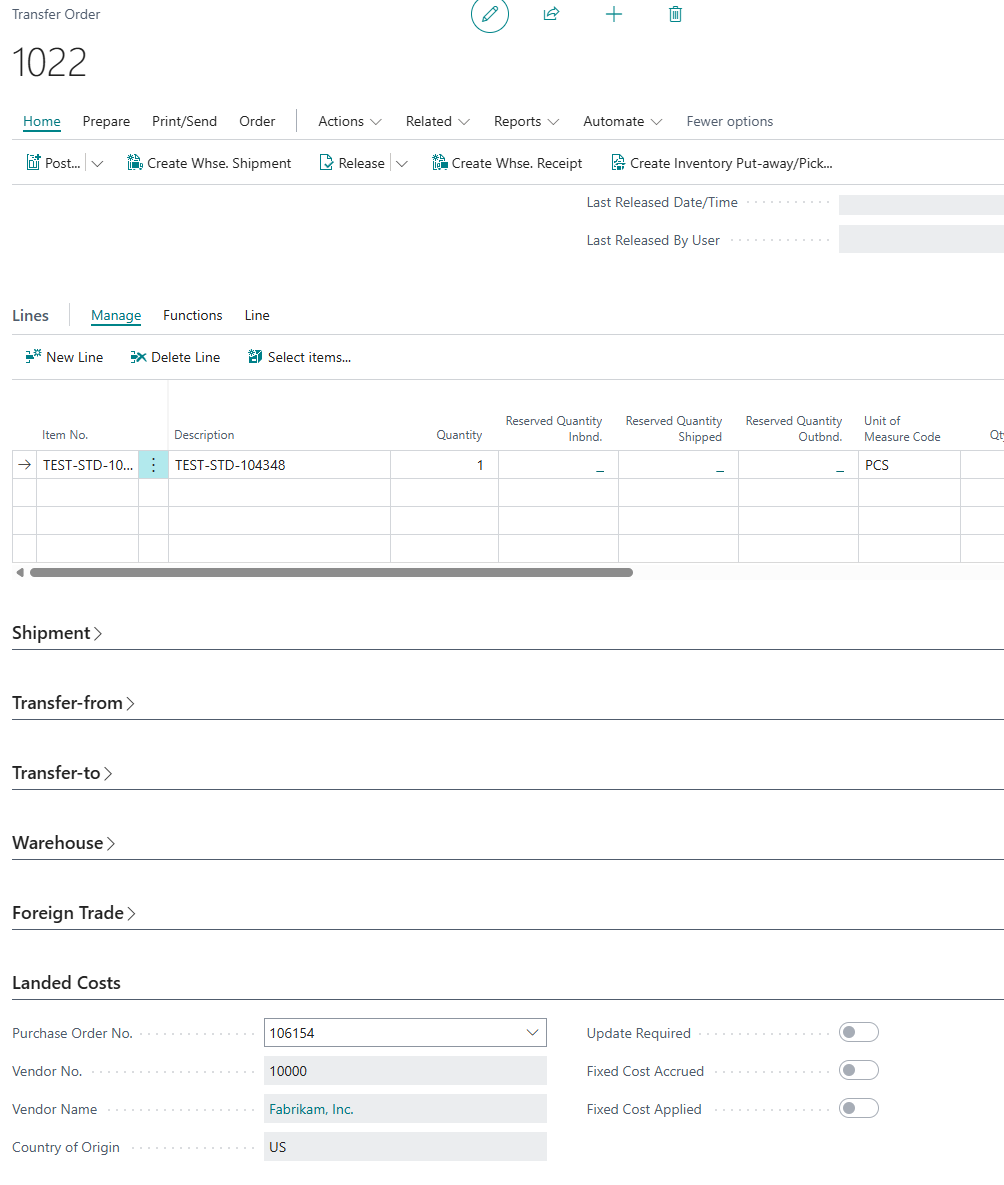
On the associated Transfer Order, the Purchase Order information is added to a new Landed Costs FastTab to allow you to identify the Purchase Order No. that is linked to the Transfer Order and for the system to be able to update the Transfer Order after the Purchase Order is received. More information on updating the Transfer Order can be found in Transfer Orders.